

Everyone deserves to be heard. Whether you are ordering coffee, telling a doctor where it hurts, or cracking a joke with friends, communication is how we connect with the world around us. For people who are nonspeaking, have limited speech, or whose speech changes because of a stroke, ALS, autism, cerebral palsy, or another condition, assistive technology can open that door.
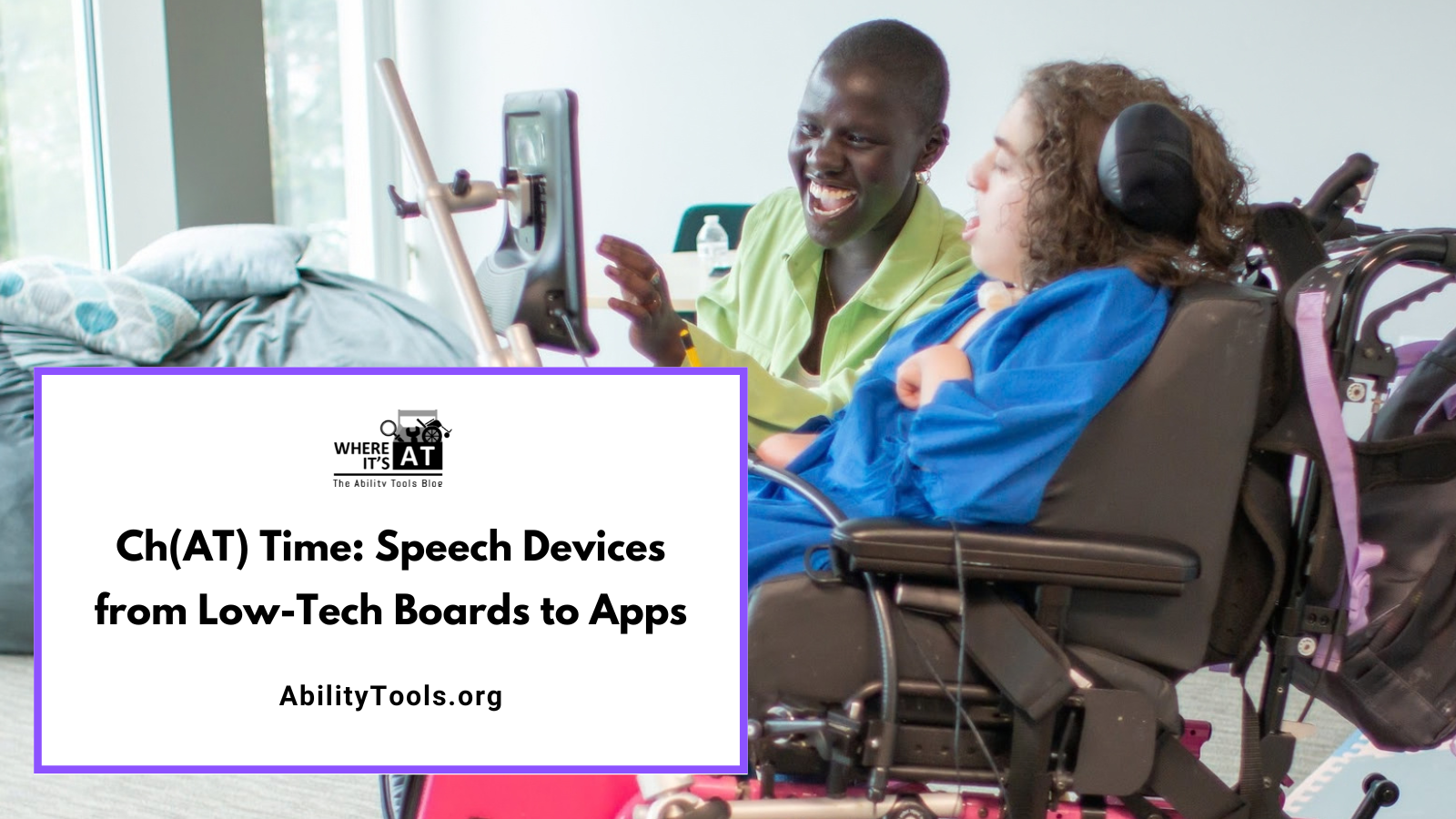
This kind of AT is called Augmentative and Alternative Communication, or AAC. AAC includes any tool or strategy that supports or replaces spoken language. And here is the good news: AAC is not one size fits all. It ranges from a simple laminated board to a powerful app on a tablet, and the best fit is the one that works for you.
Low-Tech: Simple, Reliable, Always Ready
Low-tech AAC needs no batteries, no charging, and no Wi-Fi. That makes it a great starting point and a must-have backup.
- Communication boards display pictures, symbols, letters, or words on a single page. The user points, taps, or looks at a choice to share a message.
- Communication books hold many pages of vocabulary organized by topic, like food, feelings, or places. This one can be found on Etsy from Smile4Autism.
- Picture cards and the Picture Exchange Communication System (PECS) let users hand over a picture to request an item or activity. The above PECS system can be found on Etsy at HarmonywithBethany
- Alphabet boards and eye-gaze frames (sometimes called E-Tran boards) support people who spell out messages or communicate with eye movement.
Low-tech tools are affordable, easy to customize, and perfect for the pool, the beach, or anywhere a tablet should not go.
Mid-Tech: Press a Button, Share a Message
Mid-tech devices add recorded voice output while staying simple to use.
- Single-message switches, like the AbleNet BIGmack, play one recorded message at the press of a large button. They are great for greetings, calling for help, or joining in on a song at circle time.
- Sequential message devices, like the AbleNet BIG Step-by-Step, play a series of messages in order, perfect for telling a story or taking turns in a game.
- Multi-message communicators, like the Attainment GoTalk 9+, offer a grid of recorded buttons with a paper overlay you can swap out for different activities.
These devices are a great way to build cause-and-effect skills and give a quick, clear voice in everyday moments.
High-Tech: Speech-Generating Devices and Apps
High-tech AAC gives users a large, flexible vocabulary and the ability to say almost anything.
- Dedicated speech-generating devices (SGDs) are durable tablets built just for communication, from makers like Tobii Dynavox, PRC-Saltillo, and Control Bionics. Many can be accessed by touch, switches, head tracking, or eye gaze.
- AAC apps such as Proloquo2Go, TouchChat, LAMP Words for Life, and TD Snap turn an iPad or tablet into a communication device. Text-to-speech apps like Proloquo4Text or Speech Assistant AAC work well for people who can type or spell.
- Voice banking and message banking let people who expect to lose their speech save their own voice to use later on their device.
High-tech tools can be life-changing, but they are also a big investment. That is exactly why trying before you buy matters.
Try It Before You Buy It: Borrowing a Device
Finding the right AAC system often takes some trial and error. A device that looks perfect on paper might not match how someone moves, sees, or thinks. Ability Tools’ Device Lending and Demonstration Centers (DLDCs) help Californians with disabilities test AT in real life before making a decision.
Here is how it works:
- Reach out. Contact Ability Tools or your regional DLDC in Northern, Central, or Southern California to share what you are looking for.
- See a demonstration. Staff can walk you through different devices and apps side by side so you can compare features.
- Borrow for a trial. Loans are available for up to 30 days unless otherwise arranged. Use the device at home, school, work, or in the community.
- Decide with confidence. Share what you learned with your speech-language pathologist, family, or care team. Trial data can even support a funding request.
Device loans are also helpful if your own device is out for repair, or to bridge the gap while you wait for a new one to arrive.
Let’s Talk!
From a hand-drawn board to a high-tech tablet, every voice matters and every tool has its place. Many people use a mix: an app for everyday conversations, a low-tech board as a backup, and a quick button for the moments that count.
Ready to explore? Visit our DLDC page to get started. And don’t forget to subscribe to the Where It’s AT blog for more AT tips and stories!
Product links are for information only and do not imply endorsement by Ability Tools.


